Most city-builders track population as a number. Food consumption scales with it, housing capacity caps it, and beyond that it's mostly an input to a formula. We didn't want that — we wanted the population of Crowns Edge to be the thing you actually care about, not the thing you're managing around.
What "individual" actually means here
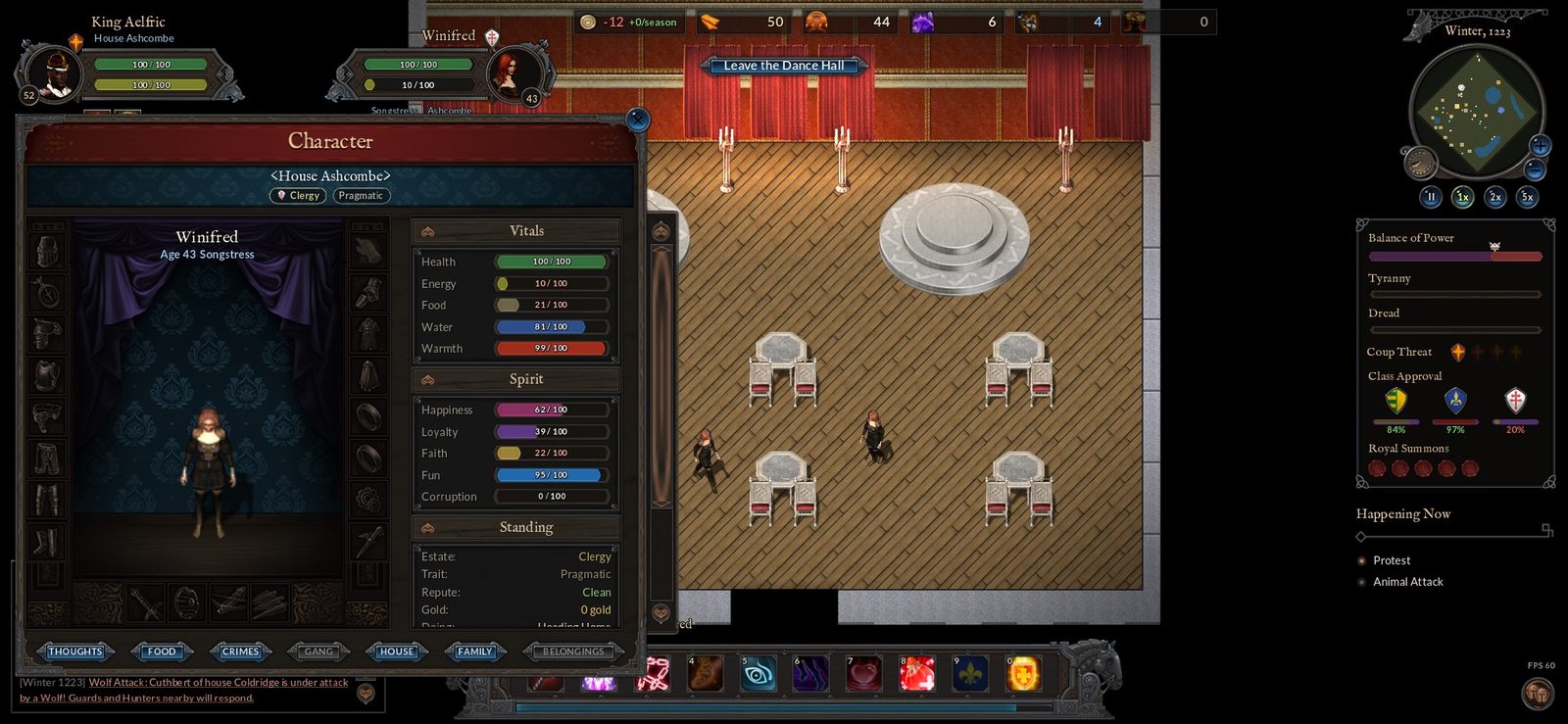
Every villager in Crowns Edge has a name, a house, an age, a job, a wage, a set of personality traits, and tracked happiness, loyalty, and grievances. They belong to an Estate — Peasantry, Nobility, or Clergy — and that estate's approval of your rule is judged separately from the others. Open the Almanac at any point and you're reading a census that's actually true.
That individuality isn't cosmetic. A villager's traits change how they behave: a Fearful villager reacts differently to a nearby robbery than a Pragmatic one. Grievances accumulate when needs go unmet, and enough of them pushes a villager toward crime, protest, or worse. When a robbery happens, it's not a random event roll — it's one named person choosing to rob another named person, and the outcome gets logged.
What it costs us
Simulating individuals instead of aggregates is expensive, and it shows up everywhere: pathfinding, scheduling, the sheer number of state machines running at once as a kingdom grows. A good chunk of engineering effort has gone into making a few thousand simultaneously-alive villagers perform well, long before that work is visible to a player. It's not glamorous, but it's the reason the rest of the simulation gets to be honest.
Why we did it anyway
Because names stick. You cut a Baker's wage to balance the books, and a year later that same Baker is the one leading a protest outside your Keep. You throw a thief in a cell, and his brother turns up in the throne room begging for his release. The kingdom remembers what you did to it, and after a few hours, so do you.